




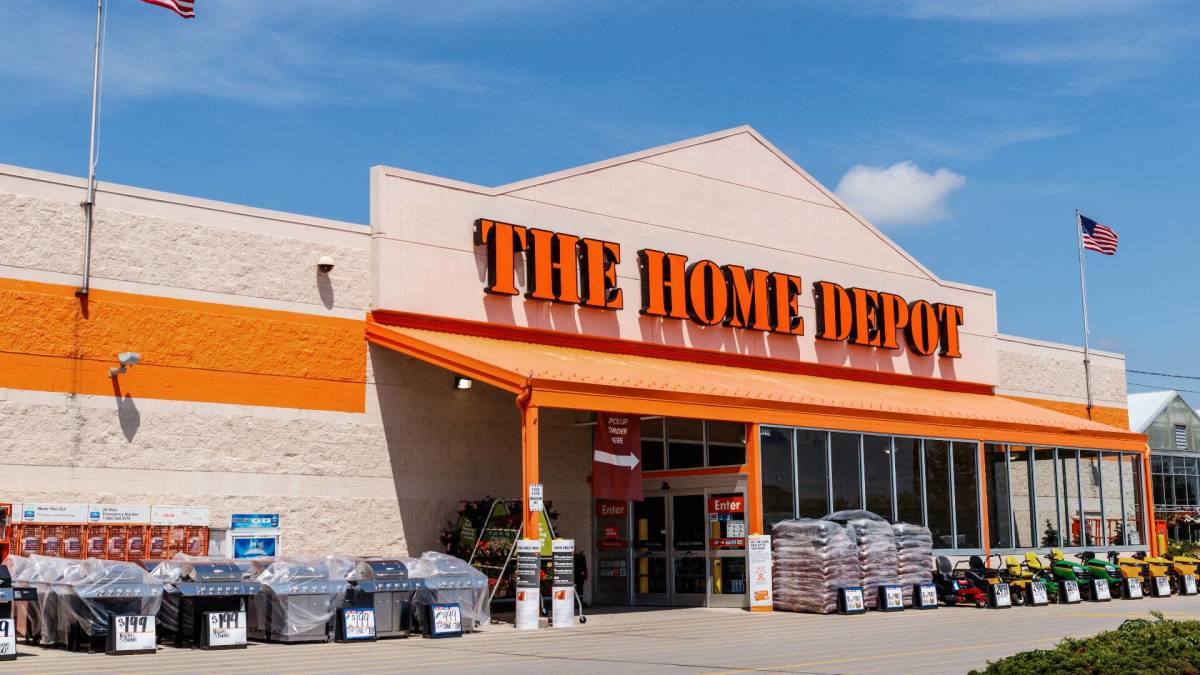

Home Depot (HD) is bracing for a transitional 2026. The retailer has struggled to grow amid stagnant home sales and homeowners retrenching. While its 2026 guidance came in above Wall Street‘s estimates, it still reflects a frozen housing market driven by high prices and reluctant sellers.
Overall, management expects total sales growth of 2.5% to 4.5% for the new fiscal year, with comparable sales expected to be flat to up 2%.
Home Depot at-a-glance (2026)
- Founded: 1978 by Bernie Marcus, Arthur Blank, Ron Brill, and Pat Farrah in Atlanta, Georgia,
- Store count: 2,300+ in North America.
- Employees: ~475,000
- Revenue (FY2025): $164.7 billion, up $5.2 billion, or 3.2%
That outlook suggests Home Depot’s 2026 revenue will grow from $164.7 billion in 2025 to a range of $170.5 billion to $172.1 billion, putting the high end of its forecast above Wall Street analysts’ consensus estimate of $171.2 billion.
Importantly for investors, the company expects adjusted earnings per share to grow 4%, suggesting EPS of $15.28, up from $14.69 in 2025, and above the analysts $15.05 consensus estimate.
The faster-than-sales profit growth signals a move to protect margins, even as big-ticket DIY projects remain under pressure.
The ‘Locked-In’ housing reality
Home Depot’s cautious outlook is rooted in a housing market that remains functionally “frozen” for the average consumer.
Despite mortgage rates stabilizing near 6.01% in February 2026—the lowest level in over three years—existing home sales plunged 8.4% in January, according to the National Association of Realtors.
Related: Home Depot cuts back key employee benefit amid customer struggles
This paradox is driven by the “lock-in” effect: millions of homeowners are tethered to pandemic-era mortgage rates of 3% or lower, making them reluctant to sell and move.
Fast fact: 20% of all mortgages are locked in at rates below 3% and 51% are below 4%, according to Realtor.com.
With the average homeowner now staying in their property for 8.5 years, the longest tenure in a quarter-century, the typical “new home” renovation cycle has stalled. This has forced Home Depot to pivot its strategy toward maintenance and professional-grade projects rather than consumer-led remodels.
It’s been tough going for Home Depot
The home improvement sector spent much of 2025 navigating a “K-shaped” recovery.
Real disposable income grew by roughly 1% year over year in December, yet consumer confidence has hovered near multi-year lows, according to The Conference Board, leading many to swap major renovations for smaller, essential repairs.
More Retail:
- Costco sees major shift in member behavior
- Home Depot over the years: A complete history of America’s biggest hardware store
- Retail chain shuts all locations as legal changes hit industry
- Lululemon struggles to reverse concerning customer behavior
“During the fourth quarter, we continued to see a resilient customer, though many continue to delay larger discretionary projects in this higher-for-longer interest rate environment,” said CEO Ted Decker.
Despite rallying 16% since September’s low, Home Depot’s stock price is about where it was trading in the Fall of 2024, suggesting many investors underperformed the broader market as the company’s sales and earnings growth stagnated.
The move up since September reflects optimism that lower interest rates will stimulate housing, boosting homeowner spending on home improvement.
“We continue to believe the broader home improvement space will see sequential improvement in 1H 2026 as it emerges from the post-COVID demand pull-forward hangover from the last 3 years,” said David Wagner, Head of Equity and Portfolio Manager at Aptus Capital Advisors.
It also reflects potential upside from Home Depot’s $18.25 billion acquisition of SRS Distribution, which is pivoting sales toward the arguably more stable “Pro” contractor market, helping reduce its reliance solely on DIY shoppers.
“We are encouraged by the momentum in our Pro ecosystem and the integration of SRS, which we believe positions us to take share in a recovering market,” said Decker.
Home Depot’s Q4 earnings backdrop
Home Depot’s guidance overshadowed a quarter that was technically a “beat” but showed the scars of a shorter fiscal calendar.
- Q4 Revenue: $38.2 billion (Down 3.8% YoY*)
- Adjusted Earnings: $2.72 per share (Down 13.1%), but above $2.58 estimates.
- Operating Margin: 10.5% (Down from 11.7% YoY)
- Comparable Sales: Up 0.4%, versus 0.8% last year; above -0.4% estimates.
- Comparable Customer Transactions: Down 1.6% YoY, versus up 0.6% last year.
*Note: Q4 2024 included an extra week, which added $2.5 billion in sales
Those results were good enough to send Home Depot shares 2% higher, but whether shares can continue to climb this year will depend largely on whether the frozen housing market thaws because of lower mortgage and equity loan rates.